Skip to content
Peoria Foundation

Serving Peoria and nearby areas

Bowing Basement Walls in Peoria, IL

A bowing basement wall in Peoria means wet, frozen soil is pushing in on it, and a free inspection tells you how far it has moved and what it takes to stop it.

Book a free foundation inspection

Tell us what you are seeing. A local specialist calls you back the same business day.

Local to Peoria

We connect property owners in Peoria and nearby areas, including West Bluff, North Side, North Valley, South Side, Grandview Drive and East Peoria, with one independent local foundation repair specialist.

  • Clay that holds water

    Ipava, one of the most common soils in Peoria County, has a subsoil of 35 to 42 percent clay. USDA says its water table can rise to 1 to 2 feet down from January to May. That wet, heavy soil sits right against the wall.

  • Frost at the top of the wall

    The City of Peoria sets footings at least 36 inches deep, and Peoria County uses 42 inches. The top few feet of soil next to the wall freeze each winter. Frozen soil swells and pushes the upper part of the wall in.

  • A lot of block walls

    About 7 in 10 Peoria homes were built before 1980. Block walls from that era are held together by mortar joints, and those joints are where bowing starts.

What it costs

Typical published ranges for Peoria. The contractor's written estimate is the price, and the inspection is free.

WorkTypical range
Foundation inspection and written estimate Free
Wall anchors $500 to $1,000each
Steel or carbon fiber wall straps $85 to $280per linear foot
Bracing a 20-foot wall with anchors $1,600 to $3,000
Bowing 20-foot wall, bracing up to pushing straight $1,600 to $11,000

See typical foundation repair prices in Peoria

What a bowing wall looks like

A bowing wall rarely shows up all at once. Most Peoria homeowners notice one of these first.

A long sideways crack

It runs across a block wall, often three or four rows down from the top.

A belly in the middle

Stand at one end and look down the wall. The middle leans into the room.

Stair-step cracks at the ends

The crack zigzags up from the corners toward the sideways crack.

A gap at the top

The wall has slid in under the wood sill, or the top row of block sticks out.

Shelves that no longer sit flat

Things leaned against the wall tip forward.

Water along the crack

The sideways crack gets damp after rain or snow melt.

Paneling or drywall that pops

In a finished basement, seams split or trim pulls away.

To check it yourself, hold a long straight board or a tight string against the wall from floor to top. If the middle touches and the ends do not, the wall is bowing. Write down how far it is from the string at the worst spot, with the date.

Why basement walls bow in Peoria

A basement wall is built to hold the house up. It is not built to hold back a lot of side pressure. In Peoria, the soil puts side pressure on it twice a year.

In winter, wet soil near the top of the wall freezes. Frozen soil swells, and the only way it can go is up or sideways. It pushes on the top half of the wall. When it thaws, the wall does not always move back.

In late winter and spring, the snow melts and the heaviest rain comes. May and April are Peoria's wettest months, per the National Weather Service. Clay soil soaks up that water and gets heavy. It presses on the wall from the outside.

Block walls bend at the mortar joints, so that is where the sideways crack forms. Poured walls are stronger but can still crack and lean, mostly at the corners. Old brick walls can bulge in the middle.

Things around the house make it worse.

Downspouts that dump next to the wall

They soak the soil right where it pushes.

A yard that slopes toward the house

Rain runs to the wall instead of away.

Heavy trucks or a driveway along the wall

Weight on the soil adds pressure.

No drain at the footing

Many older Peoria basements were built without one, so water stays in the soil.

When a bowing wall is urgent

Some bowing has been there for decades and moves very little. Other walls are moving now. These are the signs that point to a wall that needs attention soon.

The bow has grown

Your string test shows more lean than last year.

The crack is getting wider

It started as a line and now you can slip a coin in.

One side of the crack sticks out

The top half of the wall has slid past the bottom half.

The top has shifted

The wall has moved in under the sill plate.

New cracks upstairs

Doors stick or drywall cracks above that wall.

A bow that is small and steady is often a bracing job. A bow that has moved a lot, or a wall that has sheared at the crack, may need to be dug out and rebuilt. That is a bigger job, which is why it pays to look early.

How a bowing wall gets fixed

The fix depends on how far the wall has moved, how much room there is outside, and whether the basement is finished.

Carbon fiber straps

Thin straps are glued to the wall every few feet. Many contractors use them for walls that have moved about 2 inches or less. No digging outside.

Wall anchors

A steel plate goes in solid soil out in the yard. A rod runs through the wall to a plate inside. The crew can tighten them over time to pull some of the bow back.

Steel beams

Upright steel beams are bolted to the floor and the floor joists. They work when there is no room to dig in the yard, like a close lot line.

Dig out and straighten

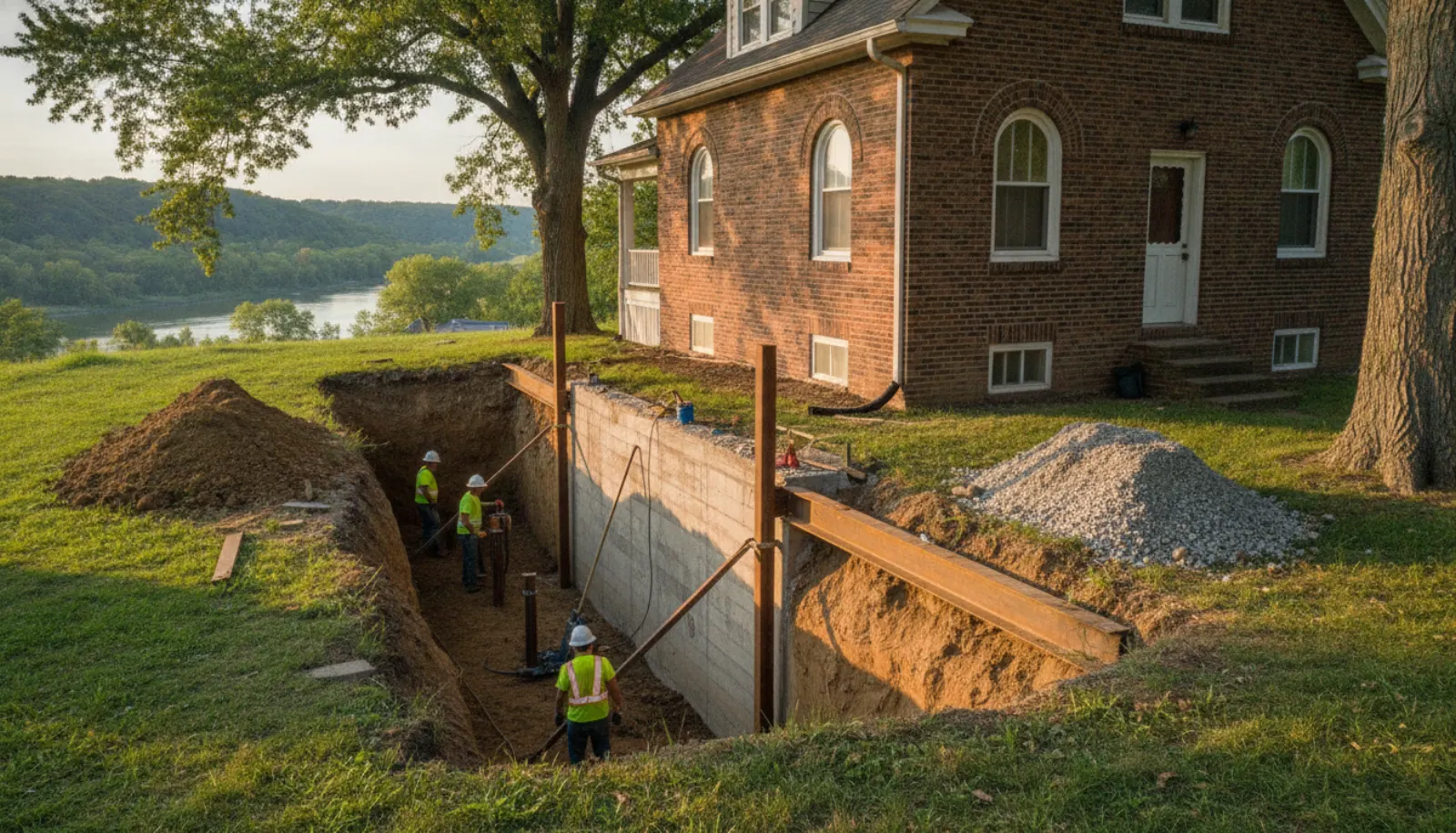
The crew digs along the outside, pushes the wall back, and braces it. This costs more but gets the wall closer to straight.

Rebuild

A wall that has moved too far is taken down and built again.

Most jobs also deal with water. Fixing downspouts, the yard slope, or adding a drain takes pressure off the wall so the brace does not have to fight it every spring.

What it costs

Bracing a bowing wall is usually priced by the anchor, the strap or the foot of wall. Published guides put wall anchors at about $500 to $1,000 each, often spaced about every 5 feet. For a 20-foot wall, bracing jobs often land between about $1,600 and $3,000. Pushing the wall back straight can raise that to about $11,000. These are typical ranges, not a quote. Your written estimate counts every anchor or strap.

Illinois law requires a written contract with the total cost for home repair over $1,000. Ask for a drawing that shows where each brace goes.

What to do before the inspection

Measure the bow

Use a string or board and write the number and date on the wall.

Mark the crack ends

A pencil line at each end shows if it grows.

Take photos

Put a coin or tape measure in the shot for scale.

Move water away

Extend downspouts at least a few feet from the wall.

Clear space

Move boxes and shelves a few feet off the wall so the inspector can see it.

Do not patch it yet

Filling the crack now hides how much it moves.

Frequently asked questions

Is a bowing basement wall a deal breaker when buying a house?

Not always. Many bowed walls can be braced for a few thousand dollars. Get a written repair price before closing, and ask whether the bow is still moving. A wall that has moved a lot or is cracked through costs more.

How much bowing is too much?

Any bow is worth a look. Many contractors say carbon fiber straps work best when a wall has moved in about 2 inches or less. Past that, anchors, beams or a rebuild are more likely.

Will wall anchors make my wall straight again?

Usually not all the way. Anchors stop the wall from moving and can be tightened over time to pull some of the bow back. Getting a wall fully straight often means digging outside and pushing it back, which costs more.

Why did my wall start bowing after so many years?

Frost and wet soil push on the wall every winter and spring. Over decades, the mortar joints in a block wall give a little each year. Clogged gutters or a changed yard slope can speed it up.

Can I finish my basement if a wall has bowed?

Brace the wall first. Drywall over a moving wall hides the warning signs and will crack. Some bracing options sit flat enough to finish over.

Do I need a permit to brace a basement wall?

Often yes. Peoria County says a permit is needed for repairs of a building. The City of Peoria has its own rules. Ask the contractor who pulls the permit and whether it is in the price.

Get the wall looked at for free

A wall that moved a little this winter can move more next spring. Call (309) 245-0953 or send the short form. A local foundation crew will measure the wall for free and give you a written price before any work starts.

(309) 245-0953 Free inspection