Skip to content
Peoria Foundation

Serving Peoria and nearby areas

Wall Anchors for Bowing Basement Walls in Peoria, IL

Wall anchors stop a Peoria basement wall from pushing in, and a local crew gives you a free inspection and a written price first.

Book a free foundation inspection

Tell us what you are seeing. A local specialist calls you back the same business day.

Local to Peoria

We connect property owners in Peoria and nearby areas, including West Bluff, North Side, North Valley, South Side, Grandview Drive and East Peoria, with one independent local foundation repair specialist.

What it costs

Typical published ranges for Peoria. The contractor's written estimate is the price, and the inspection is free.

WorkTypical range
Bowing wall inspection and written estimate Free
Wall anchors $500 to $1,000each
Wall anchors by length of wall $80 to $150per linear foot
Steel or carbon fiber straps $85 to $280per linear foot
Carbon fiber strips $900 to $2,000per crack
Helical tiebacks $1,000 to $3,000each
Wall straightening $340 to $550per linear foot
A typical 20-foot bowing wall, by method $1,600 to $11,000

See typical foundation repair prices in Peoria

Is your basement wall pushing in?

A bowing wall is a common problem in older Peoria basements. Here are the signs homeowners usually notice.

A long sideways crack

It runs across the wall about halfway up or a few blocks from the top.

A bulge in the middle

The wall leans in when you sight down it.

Stair-step cracks at the ends

The crack zigzags along the mortar near the corners.

A gap at the top

The top of the wall has slid in under the wood frame.

Water at the crack

The crack gets damp or leaks after rain.

If you see any of these, get a free look. A wall that has started to move usually keeps going until something stops it.

Why walls bow in Peoria

The soil pushes on the wall from the outside. The wall is only so strong, and block walls are weakest at the mortar joints.

Three things in Peoria make that push stronger. First, many local soils hold water and drain slowly. In spring the wet layer can sit just a foot or two below the surface. Wet soil is heavy, and it leans on the wall. Second, the ground here freezes deep, and frost in the top few feet of soil swells and shoves on the top of the wall. Third, many Peoria homes are old. A block wall that has gone through decades of freeze and thaw has had a lot of time to move.

That is why the crack on a bowing wall often shows up near the top or the middle.

How a local crew braces a wall

The right fix depends on how far the wall has moved and how much room you have outside. The contractor we connect you with will lay out the choices and put the plan in writing.

Wall anchors

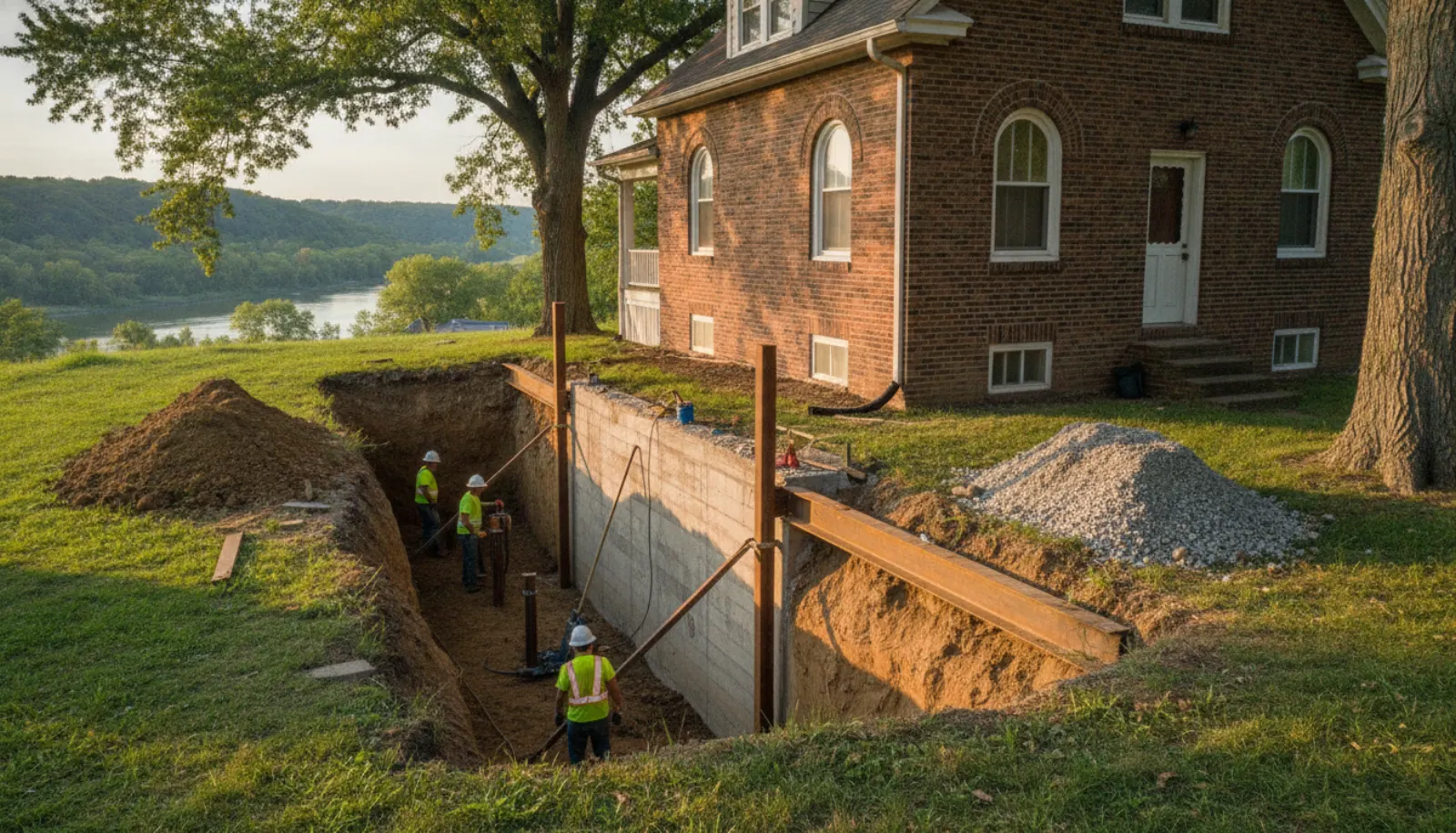
A steel plate goes into solid soil out in the yard. A steel rod runs through the wall to a plate on the inside. The crew tightens the rod to hold the wall. Later, the rod can be tightened a bit more to pull the wall back slowly. This works well when there is room to dig.

Carbon fiber straps

Thin, strong straps are glued to the inside of the wall from floor to top. They stop more movement but do not pull the wall back. This works best for walls that have moved only a little. It needs no digging and takes up almost no space.

Steel beams

Steel beams are set floor to ceiling against the wall, a few feet apart. They hold the wall in place from the inside. This is a good choice when there is no room in the yard.

Helical tiebacks

A long steel shaft with blades is screwed through the wall into the soil outside. It holds like an anchor but needs less yard space. It is often used near driveways and close lot lines.

Rebuilding the wall

When a wall has moved too far, it may need to be dug out and rebuilt. This is the biggest job and is not common. A good inspector will tell you if a brace can still work.
Fix the water too

Bracing the wall stops the movement, and fixing the water takes away some of the push. Ask the crew to look at your gutters, downspouts and the slope of the yard. If water gets in at the crack, a basement waterproofing drain may also help. Many jobs do both at once.

What a good inspection covers

How far the wall moved

The crew measures the bow at several points.

Whether it is still moving

They look at fresh cracks and old repairs.

What is outside

They check room for anchors, driveways and lot lines.

What is behind it

They ask about water, gutters and the slope of the yard.

The other walls

They check every wall, not only the one with the crack.

A written plan

You get the fix, the number of anchors or braces and the price.

What it costs

The number of anchors or braces moves the price most. Most walls get one every 4 to 6 feet. The ranges on this page come from published guides, including HomeGuide and Fixr. They are typical ranges, not a quote for your home. Your estimate shows how many braces, where they go and what is included. See the Peoria cost guide for more.

Questions to ask before you sign

How many braces, and where?

Ask for a drawing that shows each one.

Will the wall come back?

Ask how much they expect to pull it back, if any.

Who comes back to tighten?

Ask if tightening visits are included in the price.

What does the warranty cover?

Ask if it moves to the next owner.

What about the water?

Ask what they will do about the push from outside.

Frequently asked questions

How much do wall anchors cost?

Published guides put wall anchors at about $500 to $1,000 each, or about $80 to $150 per foot of wall. A 20-foot wall often runs about $1,600 to $3,000 with anchors. Your exact price comes in writing after the free inspection.

How far can a wall bow before it needs work?

There is no safe number to wait for. A wall that has a long sideways crack or a bulge in the middle should be looked at soon. The crew measures how far it has moved and checks if it is still moving.

Will wall anchors push my wall back straight?

They can pull it back a little over time. The crew tightens the anchors when the soil is soft, often in spring. Walls that have moved a lot may not come all the way back.

What if my neighbor's house is too close to dig?

Wall anchors need a clear stretch of yard outside the wall. If there is no room, steel beams or carbon fiber straps brace the wall from the inside with no digging.

Will they tear up my yard?

Most anchors need only a small hole for each plate and a narrow path for the rod. The crew fills the holes when they are done. Your lawn usually grows back in a few weeks.

Do I need to fix the water too?

Often, yes. Wet soil and frost are what push the wall in. Better gutters, longer downspouts or an inside drain take some of that pressure off.

Do anchors work on block, brick and poured walls?

They work on block and poured walls. Old brick or stone walls are different and may need another fix. The inspector will tell you what fits your wall.

Stop the wall before it moves more

Every winter of frost can push a wall a little farther. Call (309) 245-0953 or send the short form. A local crew will call you back, usually the same day. The inspection is free, the price comes in writing, and the choice is yours.

(309) 245-0953 Free inspection